Case study · Municipal
Mechanical ventilation and gas detection — new salt storage building, City of Montreal
Mechanical ventilation and a Belimo CO/NO₂ gas detection system that starts the fans on its own — so worker protection doesn’t depend on anyone remembering to switch it on.
✓ Client: City of Montreal
✓ New-build salt storage facility
✓ RBQ 5844-3979-01


The brief
Background
A salt storage building isn’t an ordinary warehouse. Equipment drives in, manoeuvres, loads and drives out — several times a shift, through the winter, inside an enclosed volume. The building was new, so ventilation and gas detection had to be designed in rather than added afterwards.
Combustion gases from the equipment
Loaders and trucks working inside an enclosed building give off carbon monoxide (CO) and nitrogen dioxide (NO₂). CO is colourless and odourless; NO₂ is a respiratory irritant whose effects can show up later. Neither can be reliably detected by smell, so a worker has no way of knowing they are being exposed.
Running the fans continuously made no sense
Running fans flat out all winter in an unheated building burns energy for nothing — the equipment is only present a fraction of the time. Manual control, on the other hand, depends on someone remembering. The ventilation had to decide for itself when to run.
The system
What we installed
Mechanical ventilation
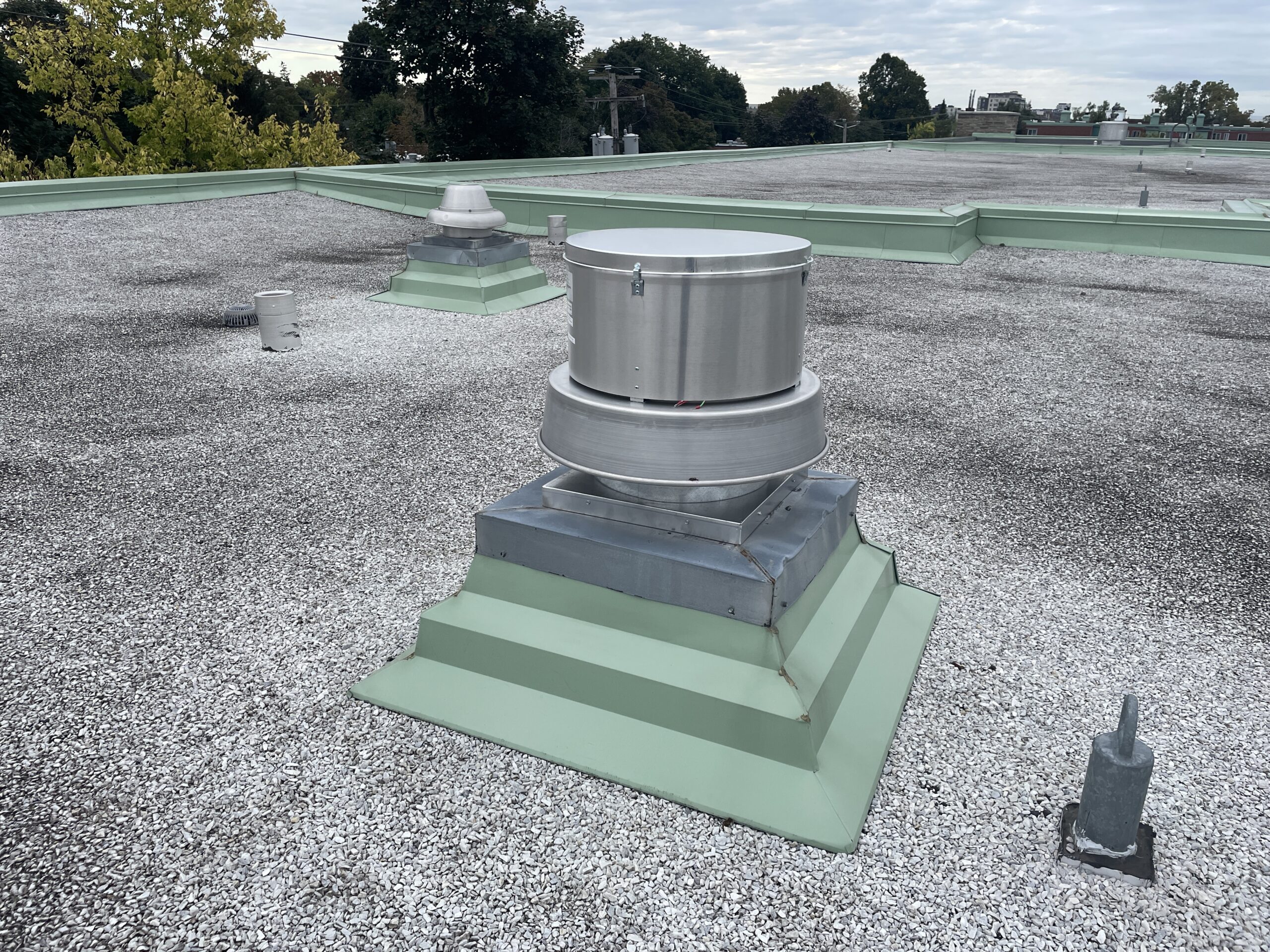
A mechanical ventilation system sized for the volume of the building and for how it is actually used: equipment entering, salt being loaded, equipment leaving.
Belimo gas detection — CO and NO₂
Belimo gas monitors continuously measuring carbon monoxide (CO) and nitrogen dioxide (NO₂) — the two contaminants that matter for combustion equipment in an enclosed space. Monitoring CO alone would leave NO₂ unwatched.
Automatic activation
The monitors drive the ventilation directly. When a concentration crosses the programmed setpoint, the fans start with no human input. When the air drops back below it, the system stands down. No button to press, no procedure to memorise, nothing to forget at the end of a shift.
That is the core of the installation: worker safety does not rest on the vigilance of someone busy loading salt.
Compliance & outcome
Compliance and regulatory framework
Nadair is an RBQ-licensed contractor, licence 5844-3979-01, verifiable in the Régie du bâtiment du Québec register. The framework that applies to this kind of installation:
- RSST — Quebec Occupational Health and Safety Regulation, Schedule 1: permissible exposure values for contaminants including CO and NO₂. This is what makes instrumented monitoring the right answer rather than a judgment call.
- Quebec Construction Code for the building and its mechanical systems.
- CNESST requirements covering worker exposure in enclosed spaces with combustion equipment.
Required permits and inspections are coordinated as part of the project — the client has no parallel process to manage.
Outcome
Worker safety during salt loading
The most exposed operation — equipment running, worker nearby, door closed — is the one that triggers ventilation. Protection engages exactly when the risk exists.
Air quality held inside the building
CO and NO₂ monitoring is continuous, not spot-checked. The air is treated according to what is actually in it, not to a fixed schedule.
A self-managing system, handed over
The building was delivered with ventilation that runs itself. Nadair installed, commissioned and handed over the system — routine maintenance stays with the City’s own provider.
FAQ
Frequently asked questions
Why install gas detection in a salt storage building?
Because the equipment loading the salt runs on combustion and releases carbon monoxide and nitrogen dioxide into an enclosed volume. Neither can be smelled. Without instruments, a worker has no way to know the concentration is climbing. Detection turns an invisible hazard into a measurable signal — and that signal drives the ventilation.
Does gas detection replace mechanical ventilation?
No — it controls it. The monitors measure, the ventilation corrects. A detector without ventilation only announces a problem; ventilation without detection runs blind. The two are one system, which is why they were designed together on this building.
Does Nadair maintain the system afterwards?
No. Nadair does installation only. We commission the system, document it and hand it over — your own team or your existing service provider takes it from there. There is no maintenance contract to sign with us.
Go further
Related pages
All projects
Other installations we have delivered.
Industrial ventilation
Factories, plants and workshop environments.
Commercial HVAC in Montreal
Our work across the island of Montreal.
Free quote
A municipal or industrial building to ventilate?
Describe the building and how it’s used. We’ll tell you what’s feasible and what isn’t.
Greater Montreal and the North Shore · RBQ 5844-3979-01 · Commercial installation only