Commercial kitchens
Restaurant ventilation installation
A commercial kitchen produces heat, grease-laden vapour and odours that have to be captured and discharged properly. It is a complete system, not a hood hung from the ceiling.
RBQ licensed
100% commercial
Free quote




Why it matters
What poor ventilation costs
Restaurant owners rarely call us out of curiosity. These are the three situations that come up.
A violation notice
An inspector finds unrated duct, insufficient clearance or a badly placed discharge. The operating permit is on the line.
An unworkable kitchen
Without enough makeup air the hood pulls air from the dining room. Doors are hard to open, drafts appear, the kitchen overheats.
Neighbour complaints
A discharge aimed at a neighbouring air intake or terrace generates complaints. That is a design problem, not a maintenance one.
The system
What proper kitchen ventilation requires
Every component depends on the others. One undersized element and the whole system works badly.
✓ A hood sized for your cooking line
✓ Rated, welded ductwork with the required clearances
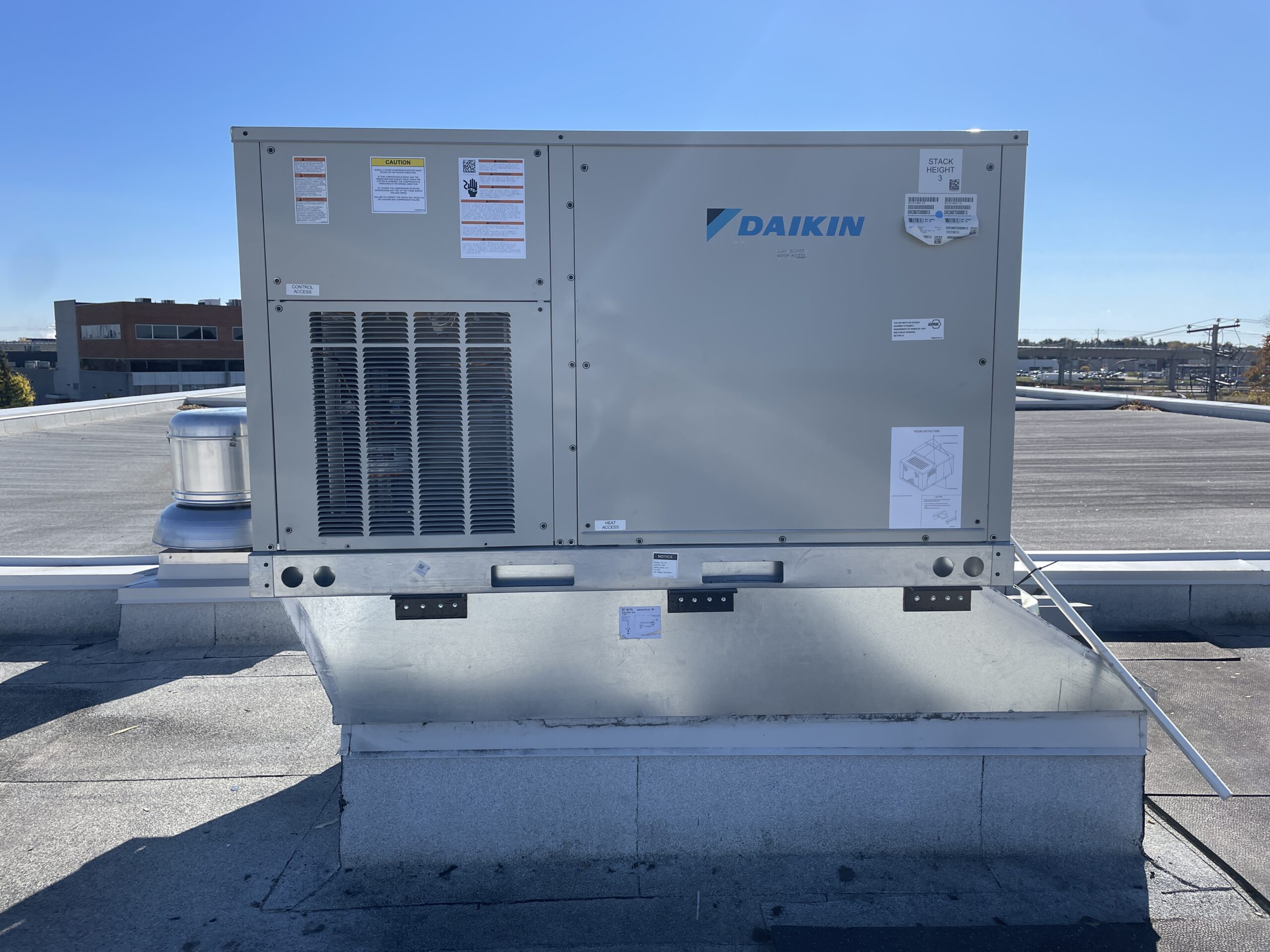
✓ A rooftop exhaust fan at the right airflow
✓ A makeup air unit that balances room pressure
✓ Access panels so grease duct cleaning is possible
Type I vs Type II hoods: choosing by cooking appliance
The hood type follows the appliances underneath it, not the size of the room. A Type I hood handles grease and smoke: fryers, griddles, ranges, woks, rotisseries, conveyor pizza ovens. It uses baffle filters, welded grease duct and an automatic fire-extinguishing system. A Type II hood handles steam, heat and odour without grease: dishwashers, steam kettles and steamers, pasta cookers. When it is close, the fire inspector decides, and we document the choice. See commercial kitchen hood installation.
Quebec regulations for commercial kitchens
Kitchen exhaust design in Quebec rests on NFPA 96 (Ventilation Control and Fire Protection of Commercial Cooking Operations), adopted through the Quebec Construction Code (National Building Code). It governs the hood, filters, duct, clearances, fan, suppression and cleaning.
MAPAQ does not certify hoods. MAPAQ issues the food permit and regulates food safety; exhaust compliance is a fire-code matter. In Quebec the local fire prevention officer is the authority having jurisdiction (AHJ) — they interpret the standard and inspect. The RBQ licenses contractors and publishes an inspection log. We build the system to pass the inspection. See NFPA 96 kitchen hood compliance.
Grease duct: materials, clearances and access doors
Grease duct is not ordinary sheet metal: it must be continuously welded, liquid-tight steel. Galvanized and aluminium are not permitted. Clearances are at least 18 in. to combustible material and 3 in. to limited-combustible material, reducible only with a listed protection system installed to its listing. The duct is sloped to a drain point, and access doors are required at every change of direction, at the base of vertical risers and at intervals on horizontal runs — grease-tight and genuinely reachable. On the roof, the fan must discharge away from air intakes, windows and combustibles. See kitchen hood inspection.
Sizing the hood to the cooking line
Airflow is set by the appliances. As a rule of thumb, a wall-mounted Type I hood needs roughly 200 CFM per linear foot for light-duty, 300 medium-duty and 400 heavy-duty cooking (charbroilers, woks); island hoods typically need more. These are planning figures — final airflow comes from the hood listing and the engineer’s calculation. An undersized or too-high hood spills heat and grease into the kitchen. See hood sizing.
Make-up air: balancing the kitchen
All the air you exhaust has to be replaced. Without a make-up air unit the kitchen goes into negative pressure: doors that fight you, back-drafting flues, cooking odours pulled into the dining room and collapsing hood capture. In practice, supply about 80–90% of the exhaust volume as conditioned outside air, with the balance from building transfer air. The make-up unit must start and stop with the hood. In Quebec the outside air is heated in winter; introducing it through the hood (a compensating hood) is often the most comfortable option.
Demand-controlled ventilation and heat recovery
The energy-efficiency chapter of the Quebec Construction Code requires airflow reduction for kitchens whose combined exhaust exceeds roughly 2,360 L/s (~5,000 CFM). A variable-flow (smart) hood with cooking-effluent sensing cuts exhaust and make-up by at least half when cooking stops. The gains are real — energy, noise, comfort — and utility programs (Énergir, Hydro-Québec) may offer rebates. For heat, the most robust kitchen solution is a run-around water/glycol loop: it moves heat from exhaust to make-up air without ever mixing the two streams.
Permits and inspections in Montreal and Laval
A kitchen touches several permits: municipal construction/renovation (borough in Montreal, city in Laval), roof penetrations and rooftop equipment, gas and electrical connections, and sometimes a fire-prevention review. Nadair prepares and files applications, schedules inspections and hands over system documentation (equipment, compliance, commissioning). The earlier we join a fit-out, the more easily duct clearances and rooftop equipment locations are settled. Note: MAPAQ handles the food permit; the hood is the fire inspector’s file. See NFPA 96 compliance.
Our process
From assessment to commissioning
Coordinated with your operations, permits and inspections included
01
Assessment
Site visit, survey of existing equipment, roof access and building constraints. We confirm what is actually there before proposing anything.
02
Design and quote
Sizing, duct routing and equipment selection, then a detailed quote: scope of work, equipment, schedule.
03
Installation
Roof work, ductwork and unit installation, electrical and gas coordination. Scheduled around your operating hours.
04
Permits and inspections
We handle permit applications and schedule the required inspections as part of the project, under Quebec building codes.
What drives the cost
Cost depends on the cooking line and required airflow, duct length and number of elbows, roof access, whether a make-up air unit is needed, whether you add variable-flow control or a fire-rated enclosure, and the schedule (work outside service hours). We price after a site visit, with a quote that separates scope, equipment and timeline. Request a quote.
The projects we deliver
Restaurants and chains (wall or island hood, grease duct, make-up air), rotisseries and production kitchens, caterers and central kitchens, cafés and bakeries: each project starts from the real cooking line, then the duct route the building allows. See our projects.
FAQ
Frequently asked questions
What our clients ask most often
How much does restaurant ventilation installation cost?
It depends on the cooking line, the duct run to the roof, building access and whether a makeup air unit is needed. We price after a site visit, not over the phone.
My restaurant failed an inspection. How fast can you help?
We prioritise compliance work because an operating permit is at stake. Call and describe the notice you received and we will tell you quickly what is feasible.
Can you work while the restaurant stays open?
Usually yes, working outside service hours. Some steps — the final connection, a roof penetration — need a short closure that we plan with you.
Do you install ventilation for food trucks?
No. We work on permanent commercial installations in buildings. Mobile units fall under different requirements and different suppliers.
Do you clean grease ducts?
No, that is a specialised service separate from installation. We install the access panels so cleaning can be done properly.
Can you coordinate with my general contractor?
Yes. On a new fit-out, the earlier we join the project the more easily duct routing and rooftop equipment locations get settled.
Go further
Related services
Our other commercial installation pages
HVAC by industry
All the sectors we serve.
Gym and fitness HVAC
Same outdoor-air logic, different loads.
Commercial HVAC services
Our commercial installation work.
Free quote
Let’s talk about your kitchen
New opening, renovation or a compliance problem — describe the situation and get an itemised quote.
Greater Montreal and the North Shore · RBQ 5844-3979-01 · Commercial installation only
Request a quote
Need a hood or a compliance fix?
See our detailed pages: commercial kitchen hood installation and NFPA 96 kitchen hood compliance.