Warehouse and Distribution Center HVAC Installation in Montreal
Warehouses and distribution centers represent some of the most challenging environments for HVAC installation across Greater Montreal. These massive facilities combine enormous conditioned volumes, high ceilings that complicate air distribution, frequent dock door openings that create temperature swings, and operational demands that never stop. Effective climate control in these settings requires equipment and installation approaches specifically suited to industrial-scale applications.
The Montreal region hosts a significant concentration of logistics and distribution facilities, from the industrial zones along the autoroutes to the newer developments serving e-commerce fulfillment. These facilities support the supply chains that keep businesses operating and consumers supplied. Proper HVAC installation ensures worker comfort, protects temperature-sensitive goods, and maintains the operating conditions these essential facilities require.
Our warehouse HVAC installation services address the complete range of industrial climate control requirements. We install the high-capacity rooftop units that provide heating and cooling for large spaces, the ventilation systems that maintain air quality and remove equipment exhaust, and the specialized solutions that address specific warehouse challenges like dock area conditioning and spot cooling for worker stations.
Understanding Warehouse HVAC Challenges
The fundamental challenge in warehouse HVAC is scale. A typical office building might contain a few hundred thousand cubic feet of conditioned space. A modest warehouse might contain several million cubic feet, and large distribution centers can exceed ten million cubic feet of interior volume. Heating and cooling these enormous spaces requires equipment capacity far beyond typical commercial installations.
High ceilings compound the volume challenge. Standard commercial buildings might have ceilings of ten to twelve feet. Warehouses commonly feature clear heights of twenty-four feet or more, with some modern distribution facilities exceeding forty feet. Hot air rises, creating temperature stratification where conditions at floor level differ significantly from conditions at ceiling height. Effective air distribution must address this stratification to maintain comfortable conditions where workers actually operate.
Loading dock operations create continuous climate control challenges. Every time a dock door opens, conditioned interior air escapes and exterior air enters. During a Montreal winter, this means cold air rushing into the building. During summer, it means hot humid air entering. Facilities with high dock activity may see significant portions of their heating and cooling capacity consumed simply replacing conditioned air lost through dock operations.
Forklift and equipment operations generate heat and exhaust that must be managed. Propane-powered forklifts produce combustion products that require ventilation for worker safety. Even electric forklifts generate heat that adds to the cooling load. Battery charging areas require ventilation for hydrogen management.
Temperature-sensitive goods impose strict requirements on some facilities. Food distribution, pharmaceutical logistics, and certain manufacturing supply chains require precise temperature maintenance to protect product quality and comply with regulations. These applications demand HVAC systems with tighter control than standard warehouse installations.
Industrial Rooftop Unit Installation
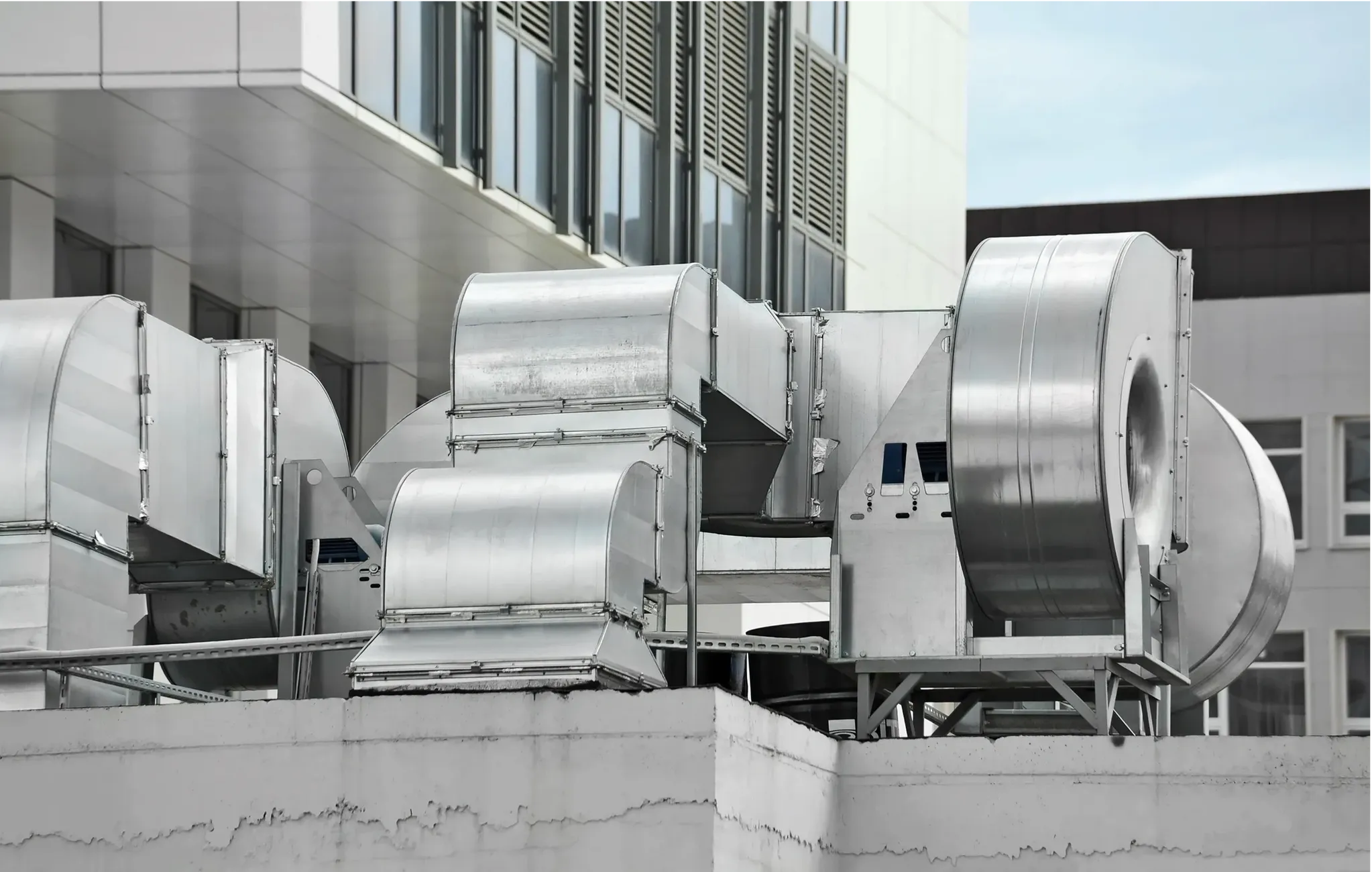
Large-capacity rooftop units form the backbone of most warehouse HVAC systems across the Montreal region. These industrial-grade packaged units deliver the heating and cooling capacity needed for high-volume spaces while keeping mechanical equipment out of the valuable warehouse floor area.
Warehouse rooftop units differ from typical commercial equipment in several respects. Capacity ratings extend well beyond standard commercial units, with individual units capable of serving tens of thousands of square feet. Construction is heavier to withstand industrial environments and roof conditions. Controls accommodate the specific requirements of warehouse operations, including the ability to integrate with building management systems that coordinate multiple units across a large facility.
Our rooftop HVAC installation services include the complete range of industrial capacity units. Equipment selection considers the specific heating and cooling loads of your facility, accounting for building envelope characteristics, internal heat gains, ventilation requirements, and dock operation patterns. Proper sizing ensures equipment can maintain desired conditions during peak demand without the energy waste of oversized systems.
Multi-unit installations are common for larger facilities. Rather than attempting to serve an entire large warehouse from a single enormous unit, multiple smaller units distribute the conditioning load across the roof. This approach provides redundancy if one unit fails, allows different zones to operate independently, and simplifies crane logistics for installation and future replacement.
Crane coordination for industrial rooftop equipment requires careful planning. Industrial units are heavy, often requiring larger cranes than typical commercial installations. Access considerations include not just getting equipment to the roof but positioning it precisely in the designated location. We coordinate crane operations as part of our installation service, ensuring equipment arrives safely in position ready for connection.
Industrial Ventilation Systems
Beyond heating and cooling, warehouses require ventilation systems that maintain air quality, remove equipment exhaust, and provide the fresh air workers need. Ventilation requirements in warehouse environments differ substantially from typical commercial buildings.
General dilution ventilation provides fresh air throughout the facility and exhausts stale air. The goal is maintaining acceptable air quality throughout the occupied space by continuously exchanging a portion of the interior air. Industrial ventilation rates typically exceed those required for commercial office buildings, reflecting the different contaminants and occupancy patterns in warehouse environments.
Process exhaust addresses specific contamination sources within the facility. Forklift charging areas require ventilation to manage hydrogen gas from charging batteries. Paint or finishing operations require dedicated exhaust to remove fumes. Certain stored materials may off-gas vapors that need exhaust management. These localized exhaust systems capture contaminants at the source rather than relying on general ventilation alone.
Makeup air units replace the air removed by exhaust systems. Without adequate makeup air, exhaust operations create negative pressure within the building, causing infiltration through doors and building openings, making dock doors difficult to operate, and potentially affecting equipment operation. Proper makeup air delivery maintains building pressure balance while conditioning incoming air for temperature and humidity.
Air circulation systems address the stratification challenge in high-ceiling spaces. Large ceiling fans, ductwork arrangements, and destratification systems push warm air that collects at ceiling level back down to the occupied zone during heating season. This improves comfort at floor level and reduces heating energy consumption by recovering heat that would otherwise be wasted at the ceiling.
Dock Area Climate Management
Loading dock areas represent a particular challenge for warehouse climate control. The constant opening and closing of dock doors creates significant infiltration, and the transition zone between conditioned interior and unconditioned exterior requires specific solutions.
Air curtains create an invisible barrier of high-velocity air across dock door openings. When doors open for loading and unloading, the air curtain minimizes the exchange of interior and exterior air. This reduces heating and cooling losses and helps maintain conditions in adjacent warehouse areas. Air curtain selection considers door size, operating conditions, and the specific climate challenges of Montreal’s temperature extremes.
Dock vestibules provide enclosed transition spaces that buffer the main warehouse from exterior conditions. Trucks dock against the vestibule, and goods move through the enclosed space rather than directly exposed to exterior weather. HVAC for dock vestibules addresses the specific conditions these spaces experience.
Dock seals and shelters close the gap between the truck and the building opening, reducing air exchange even when dock doors are open. While not strictly HVAC equipment, proper dock sealing significantly affects the performance of dock area climate control and should be coordinated with HVAC planning.
Spot heating at dock positions provides comfort for workers who spend extended periods at individual dock doors. Radiant heaters or directed warm air systems can maintain reasonable working conditions at specific locations even when general dock area heating cannot overcome infiltration losses.
Serving Montreal’s Industrial Zones
Our warehouse HVAC installation services reach industrial facilities throughout the Greater Montreal region. The area’s major industrial zones all fall within our service coverage.
Saint-Laurent in Montreal hosts one of the region’s densest concentrations of industrial and logistics facilities. The sector’s accessibility via autoroutes makes it a preferred location for distribution operations serving the greater metropolitan area. We serve Saint-Laurent facilities with the same comprehensive capabilities available throughout our coverage area.
The South Shore industrial zones along the Trans-Canada and Route 132 corridors include significant warehouse and distribution development in Longueuil, Boucherville, and Saint-Hubert. Modern distribution centers in these areas serve major retail chains and logistics operators. Our South Shore coverage ensures these facilities have access to quality industrial HVAC installation.
Laval’s industrial parks along Autoroute 440 and Autoroute 15 contain substantial logistics operations. The city’s central location in the metropolitan area makes it strategic for distribution, and industrial development continues in several sectors.
The Highway 40 corridor extending toward Vaudreuil-Dorion includes developing industrial zones that host newer warehouse construction. West Island industrial areas from Dorval through Pointe-Claire similarly contain logistics and distribution facilities.
North Shore locations from Terrebonne through Saint-Jerome include both established industrial areas and newer development serving the growing population base in that direction.
Working Around Warehouse Operations
Warehouse and distribution operations often run around the clock, and installation work must accommodate operational schedules that differ from typical commercial buildings. Our approach to warehouse HVAC installation recognizes these realities.
Installation scheduling coordinates with your operational requirements. Many warehouses experience peak activity during daytime shifts with reduced activity overnight. Some facilities have peak seasons with periods of reduced activity. We work with your operations team to identify windows for installation work that minimize impact on your core activities.
Phased installations allow work to proceed in sections while maintaining operations in other areas. For multi-unit rooftop installations, we can complete equipment one unit at a time rather than requiring the entire system to be offline simultaneously. This approach maintains conditioning in operational areas while new equipment is being installed.
Safety coordination is essential in active warehouse environments. Forklift traffic, racking systems, and ongoing material handling all create considerations for installation work. We coordinate with your safety personnel to ensure installation activities integrate safely with warehouse operations.
Frequently Asked Questions
How much does warehouse HVAC installation cost in Montreal?
Costs vary significantly based on facility size, equipment requirements, and installation complexity. Industrial rooftop units are more expensive than standard commercial equipment, and larger facilities need multiple units. We provide detailed quotes after assessing your specific facility and requirements.
How long does warehouse HVAC installation take?
Timeline depends on project scope and equipment lead times. Industrial equipment may require longer lead times than standard commercial units. The installation work itself might take several days to several weeks depending on the number of units and complexity. We provide projected timelines during the quote process.
Can you work while our warehouse is operating?
Yes, we coordinate installation scheduling to accommodate your operations. Many installations can proceed during off-peak hours or in phases that maintain conditioning in active areas while work proceeds elsewhere.
What types of warehouses do you serve?
We serve all types of warehouse and distribution facilities including general warehousing, e-commerce fulfillment, logistics and distribution centers, manufacturing warehouses, wholesale operations, and cold storage facilities. Each type has specific requirements that we address through appropriate equipment and installation approaches.
Do you handle ventilation for forklift operations?
Yes, proper ventilation for forklift operations is part of comprehensive warehouse HVAC. This includes general ventilation for propane-powered equipment and specific ventilation for battery charging areas.
How do you address the high ceiling challenge?
Air distribution for high-ceiling spaces requires equipment selection and ductwork design that accounts for stratification. We specify high-throw supply systems and may incorporate destratification equipment to maintain comfortable conditions at floor level.
What about temperature-controlled warehouses?
Temperature-controlled storage requires tighter climate control than standard warehousing. We can address these requirements through equipment selection and controls, though specialized cold storage may require refrigeration contractors for the primary cooling systems.
Related Services
Our warehouse clients often need services beyond standard HVAC installation. We provide rooftop unit installation for buildings of all types. Warehouse facilities with attached manufacturing operations may need process ventilation alongside general HVAC. Facilities with office components benefit from our commercial HVAC services for those areas.
Request a Warehouse HVAC Quote
Contact us to discuss HVAC installation for your warehouse or distribution center. We provide thorough assessments and detailed quotes for industrial facilities throughout Greater Montreal, Laval, the South Shore, and surrounding regions.
Email: projets@nad-air.ca
Phone: (514) 213-0626